Absolutely Under No Circumstances
A photographer hired to take pictures of a house for sale slowly loses her mind.
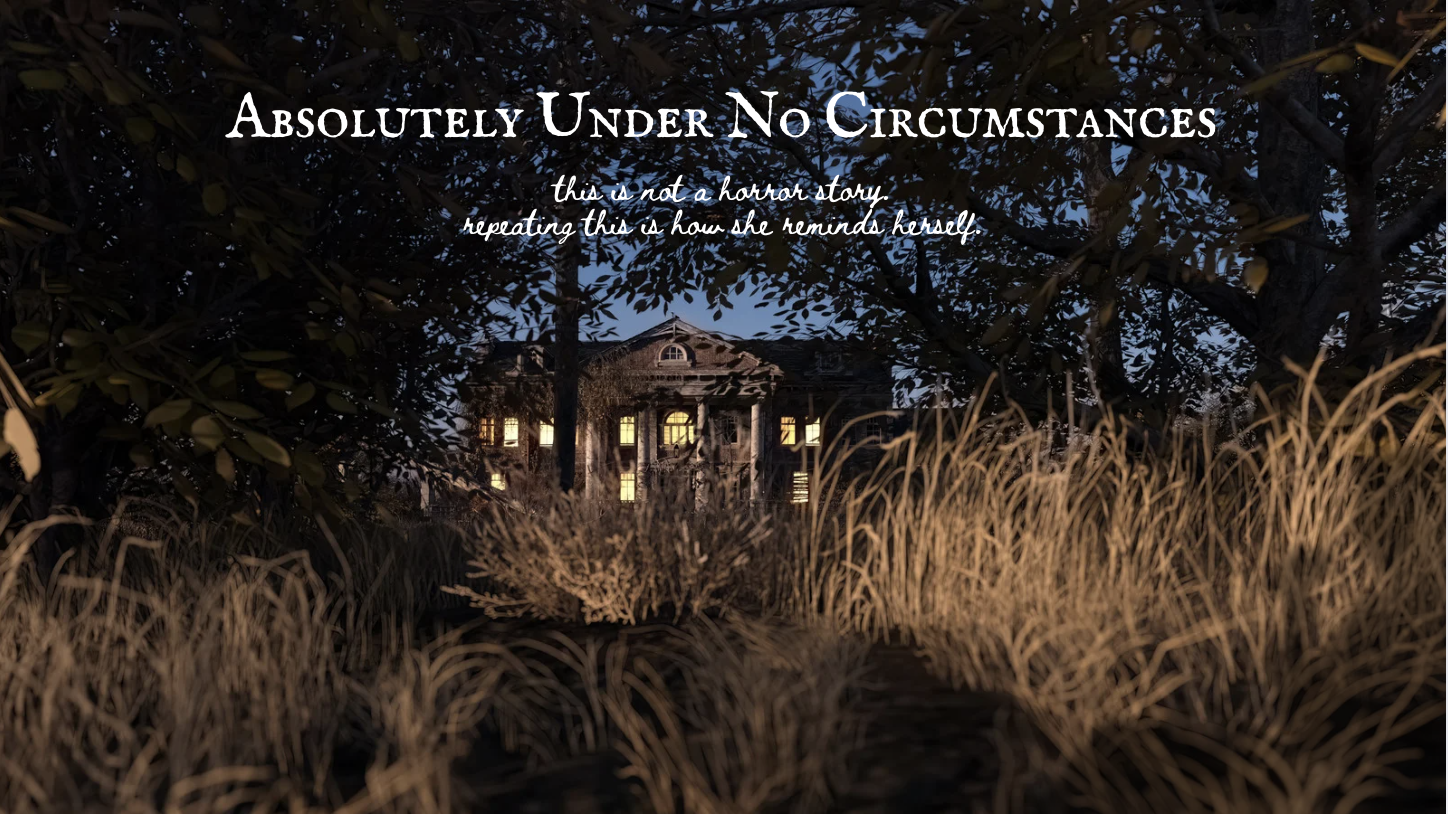
Absolutely Under No Circumstances is, in fact, a horror story. More specifically, it is a ghost story. I originally wrote this while experimenting with shorter fiction and have been revising it on and off for years. For me, it carries traces of a Shirley Jackson story with a particular isolated focus. While it’s an earlier attempt at my forays into writing horror, I’m still proud of the atmosphere it conjures and the particular wordplay I used in certain sections.
Read Absolutely Under No Circumstances here:
This is not a horror story.
Repeating this is how she reminds herself.
Maybe it looks like one. The old house with its turrets. The dead and dying flowers along the walk. The dark shadows that cloud the corners of her vision. But this is not a horror story.
It’s not the opposite of horror story. In fact, if she focuses very, very, hard, this could not even be a story at all.
The house itself is old. Old, old house. Built well over a hundred years ago, as old as anything is in this part of the country. It’s big and it’s wide and it yawns open from the front doorway like some great cavernous beast. Like a living, breathing old house.
The house is alone for an expanse of a hundred miles in any direction, declares the tingling sensation at the back of her skull. She is not alone within the house, though the house, itself, is alone. A singularity striking out from the gaping darkness at the center of the clearing. The trees, breathing though they be, are not suitable company.
There is a gravel driveway that has not seen a single car since it was laid; read the tire tracks or lack thereof. The gravel driveway is lined with flowers that have not been watered: read their wilted petals. This is not a horror story, groans the metal gate. This is not a horror story, whispers the wind through the trees. This is not a horror story, says the girl and her camera and her fearless, fearless eyes.
The front entryway is as normal as normal gets. A plush carpet leads halfway down the hallway, stops at the foot of the stairs. There are picture frames, though empty, on a shelf. There is an open doorway leading to a dusty sitting room that contains a large grand piano. There is a key in a door that appears simply closed; when she tugs on it, the knob doesn’t budge. Locked doors in old houses make noises like swelling wood in sickly summer heat, but it’s autumn now and she doesn’t trust this house.
Good evening, says the first picture she takes, of the chandelier in the dining room. Someone has died here. You won’t know how, you won’t know who, you won’t know where. But someone has died here. Wandered into the dark and gotten a little too lost. The tinkling of the chandelier like a schoolgirl’s laugh. Uncannily rendering girls she avoided in school.
The second picture she takes, of the curvature of the stairs, reminds her that she is here to tell someone how good this house is, this good old house. The house with three floors in the forest all alone for a hundred miles would make a wonderful place for you to raise a family, what space. It yawns like an open mouth for you if you want it to. You won’t feel like you don’t belong here, no, never: says the painting hanging in the piano room. Says the dust on the keys captured by the camera’s shutter:
Someone played me once and died. Who was it? Why was it? Where do you find more dust than usual: the fireplace or the kitchen stove? Hot, heat, sweltering. The camera lens fogs with a breath she did not breathe, and she wipes it away.
A quick shot of the locked unlocked door in the hallway. To reassure herself, upon returning to the sensible rental car parked at the head of the road, that there was at least one thing she didn’t imagine. Perhaps on the way out she might be able to spot the realtor’s sign she meant to look for on the way in.
This is not a horror story written on the kitchen walls in lighter fluid. The stove is turned on and just barely warm. The whistling of a teakettle makes her want something to drink. Someone died here. Someone drank poison tea and swallowed the swallow. Where is the bird cage?. If you leave a body for long enough, she wonders, does the soul leak into the floorboards?
The greenroom has beautiful windows, she says with pictures, and the dining room has a table long enough for a hundred guests. These are all good things, part of this good, old house.
Upstairs the camera shutter says check for ghosts in each dark corner, but looking through the fisheye makes her smell smoke and oil and burnt leaves. First bedroom with a blue duvet and sunlight on the walls. The bedroom faces east.
Under dark corners in dark corners around dark corners insists the camera shutter and the house whispers back a soothing lullaby about cats and cradles. She takes pictures of a dresser and a rug old enough to be dust and smooths the tip of her tongue against the top of her teeth. Drawing it back, she hears a hiss, she tastes burning metal. Rugs turn to dust turns to char under her feet.
In the nursery there is a bassinet, in the bassinet there is a baby doll with its hands sticking straight up for a shadow-mother to rock it. The wallpaper tells her it’s not there, the camera shutter says maybe this is a horror story, she says is the baby getting enough sleep? With all of this rocking?
Underneath the tables and chairs there is nothing but shadows and she takes pictures of them anyway. She finds motor oil tread into the carpeting in the master bedroom and empty perfume bottles in the sink and this is the only sign she can recognize that someone was ever here. You didn’t believe us, says the house, and look how foolish you’ve been. Everything smells like the whistling teakettle, left too long on the stove. The camera shutter flinches when it closes.
In the bathroom the mirror looks empty and the camera asks is this a horror story? Who can tell anymore?