FEAST WHILE YOU CAN - MIKAELLA CLEMENTS, ONJULI DATTA
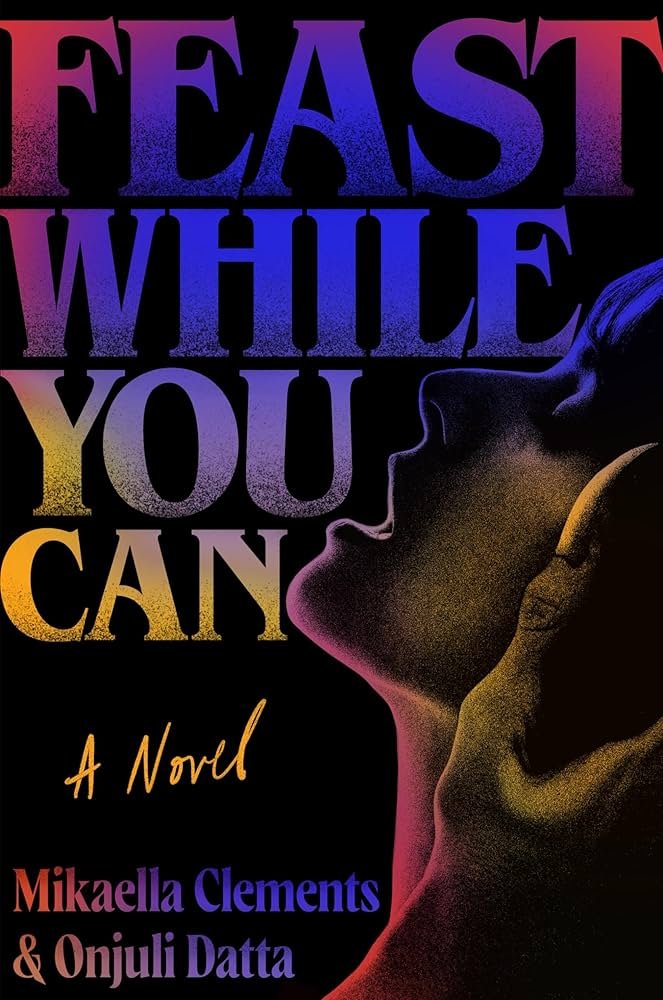
pairs well with: thunderstorms, turning the lights on in your room and covering the mirrors, cherry soda, an undying love for someone who is destroying you.
rating: 5 stars
tags: well-written, sapphic, grotesque, surprising, yearning, still-thinking-about-this-one
WARNING: Spoilers ahead.
I’m usually hesitant to take book recommendations from social media; I find that my tastes rarely align, at least in literary form, with whatever’s popular. However, when I came across a rogue TikTok excerpting a scene from Feast While You Can in which the romantic love interest describes the emotional satisfaction of wearing a packer, I figured I had stumbled across something pretty special.
The 2024 novel, written by married couple Mikaella Clements and Onjuli Datta, is set in a remote, slightly backwater mountain town called Cadenze. Angelina Sicco is the only girl in the current generation of her influential extended family, the “chosen one.” Her blissful existence in the town she loves is interrupted by the return of Jagvi, her brother’s ex-girlfriend and her nascent, though unacknowledged, crush. The same night Jagvi comes back to town, Angelina begins to be haunted by a mysterious “thing,” supposedly the monster that lives in the pit in one of the town’s many dark caves. The thing eats futures, and it seems to want Angelina’s.
I personally feel that the genre of horror-romance is deeply under-appreciated. As 2020’s The Haunting of Bly Manor proved, love and haunting are intrinsically tied together, and Feast While You Can marries these two themes with stunning naturalness. Angelina’s growing possession by the thing is only halted by Jagvi’s presence and touch - love (or lust, as it exists for the first half of the novel) is the only cure to the horror. They are presented as polar opposites; the book’s surprising but deeply satisfying conclusion renders them anything but. In fact, Feast While You Can’s conclusion seems to be that love and horror are one and the same.
If I was bothered by anything in this book (and I really wasn’t), it was Angelina’s failure to see what the thing was truly after. She is a self-proclaimed homebody who plans to live in her beloved hometown and work at the local bar until she dies; Jagvi is a successful paramedic who moved to the nearby city and is dead-set on never returning to Cadenze unless forced, due to familial trauma and the town’s racist-cum-homophobic distaste for her. As the legend is described early on, the thing in the pit eats the future of its victims, gnawing on their potential and erasing them from reality. Between Angelina and Jagvi, Jagvi is the one with the more delicious future - she lives outside of Cadenze, wants a family, has a successful career. As their relationship develops and Angelina begins to stew on the idea of Jagvi remaining in Cadenze with her (her possession makes her unable to cross town borders), she frequently dismisses their connection as nothing but a fling, because there is no way Jagvi would throw away her entire future just to be with Angelina. Not once does she consider that, by making Jagvi the only antidote to the thing’s possession, that could be exactly what it wants. At least, not until it literally happens.
The fact that I predicted that twist early on is an incredibly small annoyance in the story, especially when the culmination of this realization is so intense – Angelina, possessed by the thing, literally trying to eat Jagvi’s body. The climax of Feast While You Can is shocking, horrifying and yet incredibly sad, but what makes it beautiful is what comes after.
Jagvi has spent the entire book dedicating herself to Angelina, even if Angelina cannot see it. Jagvi tells her that she has wanted her for years – even back when she was dating Angelina’s brother, before coming out as gay – and that she would do anything for her. Jagvi’s determination and devotion is not only admirable in its strength, but enviable. She protects Angelina through scare after scare, unwavering in her faith. She is even willing to be there for Angelina before she truly believes the thing in the pit is real.
And after the thing tries to devour her – and Angelina consumes it in return, restoring Jagvi and her future – Jagvi stays loyal. She remains in Cadenze with Angelina far into the future, allowing Angelina, and the thing that now lives inside her, to feed from her in order to keep her fulfilled. For Jagvi, Angelina is worth loving, monster and all. And with the thing in the pit being a loose metaphor for Cadenze as a whole, with its conservative population that had scorned Jagvi for being brown and gay, it is a measure of acceptance.
The metaphors of Feast While You Can are layered without taking away from the plot itself. The story can be taken at face value very easily while also being dug into to reveal the layers underneath about yearning, discomfort, assimilation, and family; the balance of these elements is particularly masterful. It can be easy to let an allegorical narrative dominate the textual one, but Clements and Datta measure it carefully.
The thing that impressed me the most about Feast While You Can was how authentically queer it was. I often struggle to find such a level of inherent queerness in sapphic fiction, even books or stories written by openly queer authors. The level of authenticity displayed in Feast While You Can I find often reserved for sapphic fanfiction, written by majority queer authors directly for and in conversation with a queer audience. Without the middleman boundary of a straight editorial and publicizing team, or the burden of “appealing” to wide audiences, fanfiction is able to accurately emulate the day-to-day experience of queer audiences down to the small details.
Feast While You Can reads exactly like that. Angelina and Jagvi’s relationship is messy in the way many lesbian relationships stereotypically are: Jagvi was Angelina’s brother’s girlfriend until Angelina discovered her having sex with another girl and outed her, not knowing Jagvi carried a torch for her even then. Angelina reveals her sexuality to Jagvi first, instead of her family, at a queer party in the city. Jagvi is a nuanced portrayal of a butch lesbian, which can be hard to find in most mainstream media – she even wears a packer, which I’ve quite literally never seen in a book before, and certainly not as the gender-affirming tool it is rather than something used for sex (which packers are not).
Speaking of – Feast While You Can is not ashamed to be sexy in a way that is also refreshing. With the recent trends of romantasy and series like Heated Rivalry pushing appealing explicitly sexual content (in a largely tasteful way, of course), it’s beautiful to see a purely sapphic story do so as well. It’s another element of the book’s authenticity that it does not glaze over or attempt to palatalize those elements of Angelina and Jagvi’s relationship; their romance is, in fact, driven by sex, though they are not defined by it. It’s a very delicate balance that Clements and Datta achieve.
The word I’ve been using to describe this book to others in the queer community is “dykey.” It’s a reclaimed slur, and not many are comfortable using it, which I understand, but it is simply the only word I feel can encapsulate how for the community, by the community, this book is. Reading Feast While You Can feels so much better than consuming any other piece of media that, perhaps, contains queer elements but was not developed specifically for a queer audience. Seeing yourself reflected so specifically in a piece of media is a privilege that straight consumers have had for centuries and queer consumers are only just getting to experience, and it is invaluable – especially for young sapphic girls trying to figure themselves out.
I have often tried to sanitize my own writing – the steamy, overly romantic stories can remain in the fanfiction realm, and I will focus on “respectability” for my narrative fiction. But the success of Heated Rivalry – which was never trying to be anything deep – and the extreme appeal of Feast While You Can have made me reconsider. The novel is not only representative to the sapphic community, but truly a well-written and ingeniously constructed piece of horror literature. It happens to be both at the same time. And even if it was simply a vehicle for a sapphic love story, well, to see one with such specific representation would warm my heart. If this is where we are trending in terms of queer literature, it makes me incredibly excited – not only to see what others will make next, but to contribute my own words to the story.