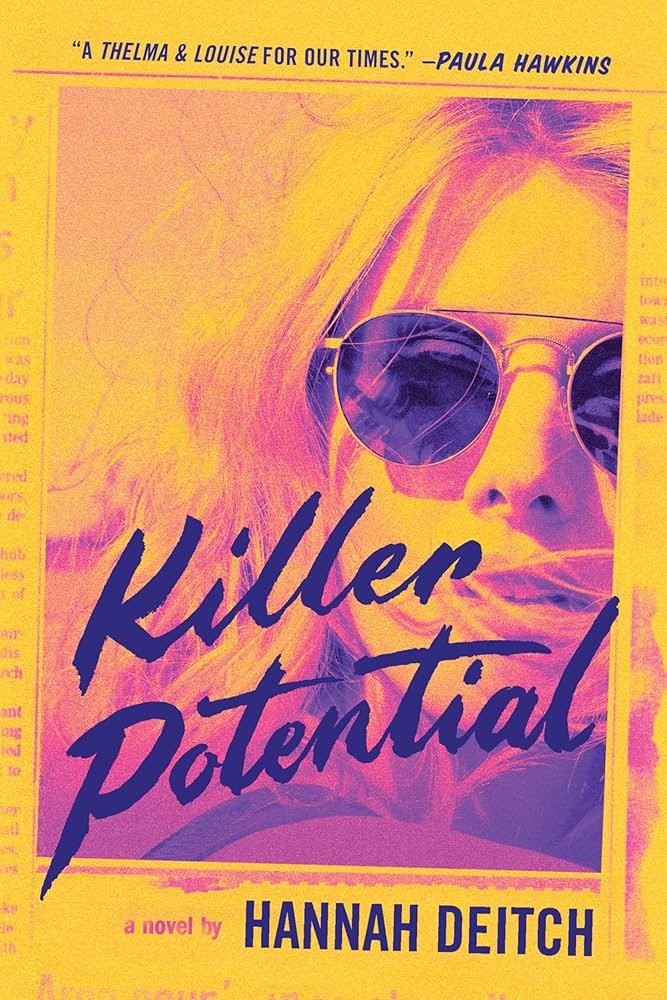
KILLER POTENTIAL - HANNAH DEITCH
pairs well with: Ricky Montgomery’s “Snow;” the soundtrack to the musical Lizard Boy, particularly “The Woah Song;” a crisp Arizona green tea; a physical hardcover copy to grip in your hands so tight the spine threatens to break.
rating: 5 stars
tags: well-written, sapphic, female-rage, be-gay-do-crime, yearning, couldn’t-put-it-down
It’s been a long time since I’ve felt like sitting down and writing a review for a novel, of all things – a medium I consume with regularity, but with a detached eye. I’m not as critical towards literary writing; I tend to be far less emotionally invested in books, as well, although I like reading them.
It’s been a similarly long time since I sat huddled under a plush blanket on my twin bed, flipping page after page as the sky grows dark out my window, desperate to reach the end of a novel. The last time I remember was my junior year of high school, breezing through the third act of The Seven Husbands of Evelyn Hugo in one night – which is now one of my favorite books.
Now, almost five years later, it’s happened again, with Hannah Deitch’s Killer Potential. A book I picked up off a bookseller recommendation card at Book Soup in downtown West Hollywood. The book takes place in Los Angeles, I’m living in Los Angeles this summer; it was described as a “Thelma & Louise for our times” on the front cover, and the reference to one of my favorite movies intrigued me. I picked it up with little reservation, even though it was an expensive hardcover. I started reading it the very next night.
That was less than a week ago.
Killer Potential has been described by some, including that fateful bookseller recommendation card, as “impossible to put down,” and I would agree. The pace of the novel is relentless, frequent chapter breaks marking breathless cliffhangers and practically begging you to turn the page. At this stage of my life (college undergrad who spends all day surrounded by words and their meanings) I don’t have the stamina for reading I once did, but I was truly engrossed in this book. So engrossed I spent my entire evening bulldozing my way to the end, squealing with every subsequent page turn.
The novel – published this year – follows Evie Gordon, a wayward academic-turned-SAT-tutor who is inadvertently caught up in a double homicide when she rescues a mysterious woman, who she believes to be a potential victim, from the house of her employers. Immediately implicated in the crime, Evie hits the road with her new companion – who she later learns is named Jae, and is a lot more competent at the criminal lifestyle than Evie. What follows is a madcap adventure trekking across the country and back, avoiding law enforcement and piling up even more bodies. Along the way, the pushy, barely-restrained rage of Evie’s personality yields to Jae’s stoicism and loyalty, and they develop feelings for one another.
Like many books I love (Seven Husbands, for one, and the underrated The Villa by Rachel Hawkins), Killer Potential is chock-full of twists and tension. A fugitive chase and an unplanned crime spree tend to do that. What I did not expect was the many introspective, impeccably-narrated passages of thoughtfulness on Evie’s part as she contemplates both her current situation – a reckoning with her reality as not only a criminal, but a subpar one, hit me in the chest – and the state of millennial academic Americans as a whole. While Evie is in her late twenties, her aspirations and subsequent failures to achieve greatness in the American academic system resonate. Evie laments that she has no true passion, nothing to work for – she is only trying to earn the A. School is the one thing she’s good at, a safety net underneath her. It’s a sentiment I share, and one that I try to work through, tirelessly, as the grindhouse system of academia churns out more and more overqualified candidates with nowhere to go in the marketplace of this stagnating economy. Evie’s past regrets are my future fears. The relatability of her character is potent.
For a first-time author, Hannah Deitch has a remarkable grasp of character voice and how to structure a narrative. She wields first-person narration – typically a red flag for me – with a deft hand. Evie’s narration is never unrealistic, nor too self-focused. Rather, her tangents build her character, and when Jae receives a chance in the spotlight in the third part of the novel, her own verbosity perfectly complements her quiet intelligence.
No elements of Deitch’s plot go unexplored or simmer in uselessness. A minor character detail used to illustrate Evie and Jae’s tense relationship early in the novel – Jae’s dislike of the song “Hey Jude” – comes to an emotional head in the final act, lending significance to everything we’ve seen before. A major twist at the third act break rightfully calls into question all you thought you knew beforehand, but the remarkable thing is that looking back, there are no obvious holes. The book asks you to go with the flow many times, but because Evie is so willing to do so in her panicked state of mind, the reader can too.
In impressive aspect of the writing to mention is the believability of Evie and Jae’s extended criminal road trip. Deitch explains things clinically and never lingers too long on the shoplifting or carjacking that might lead a reader to call her narrative into question – in fact, she uses Evie’s perspective to her advantage and leaves many of these things off-page, under Jae’s jurisdiction. When the characters get the bright idea to take over boats and use the water as a getaway avenue, it subverts reader expectations – especially those who have already been comparing this to a road story like Thelma & Louise – and introduces novelty that is nonetheless believable.
While the novel has strong thematic cores – class mobility, the 2008 recession, repressed violence, and revenge among them – the strongest element that shines through, for me, is the romance between Evie and Jae. The cascading sequence of it feels inevitable, from the first stirrings of attraction between them in a motel room to the burst of tension once they finally kiss on a stolen boat. Their queerness is a matter of fact, and not something to be ogled at, which feels refreshing. They complement each other; they feel believable as lovers. Evie is tightly-wound, controlled chaos, while Jae is quiet, watchful, patient. One demands answers, one refuses to provide them; therein lies their chemistry. There is intimacy, but Deitch doesn’t make it salacious; rather, she uses acts of submission to reinforce the characters and the novel’s themes. In fact, their relationship feeds the novel’s narrative core; the listless tutor finds her purpose and her place, and the gifted, abandoned orphan learns (even if only for a short time) that she can be loved. Their relationship is a microcosm for the book’s commentary on value, desire, and ambition.
Jae is a fascinating character study of female rage, especially because, in her tomboyish description and masculine physical confidence, she does not fit the typical definition of the trope. And yet, female rage is at play here, in its basest, genderless definition – a built-up frustration, repressed due to a societal taboo, which boils over in dramatic, often violent fashion. While the root of Jae’s anger is in a twisted sense of revenge and an unacknowledged inheritance of bitterness from her father, it expresses itself in the way that Evie’s does, as the novel progresses – bursts of spontaneous violence, caustic cynicism to the world around her, and most importantly, a sense of self-imposed isolation. Both Jae and Evie – alone, and as a unit – were isolated from society long before they were ever fugitives. The capitalist cog-filled machine long ago made it so.
I’m generally a visual person, so even with all these elements – stellar character building, strong themes, and great narration – I’m still apt to prefer a filmed version (I was delighted to learn of Nahnatchka Khan’s deal to develop this novel into a TV series). But I never yearned for that visual aspect with this book. The words do indeed leap off the page, but more than that, the story itself was captivating like a film. The characters realized in such vibrant color, the world stuffed with sensory detail.
I’ll admit, I’m the first to jump for a story about queer women, especially queer women who commit crime. (Don’t worry, this book is already on my stuff I wish I had written list.) And perhaps I’m biased. Scratch that, I definitely am. But I don’t care. I loved these characters; all I wanted – and what buoyed me through the emotional rollercoaster of the last 100 pages, if we’re being honest – was for them to be happy, to see their dreams realized. Maybe it’s because I have similar dreams, and similar fears that they will not come to fruition. Maybe it’s because I just have a weakness for these kinds of characters. Whatever the reason, this book burrowed into a very specific niche in my heart that I like to call “Ro-Core” – funny, violent, sapphic, brimming with yearning, and well-articulated.
I’m not sure if, morally, Killer Potential wants me to root for Jae and Evie, or Jae at all. But perhaps that’s the point; given enough evidence, we can believe anyone guilty of murder, but we can believe them worthy of love, too.