While cleaning up the remnants of a failed marriage, a judgmental writer comes to a startling realization about herself.
The Hole in the Drywall
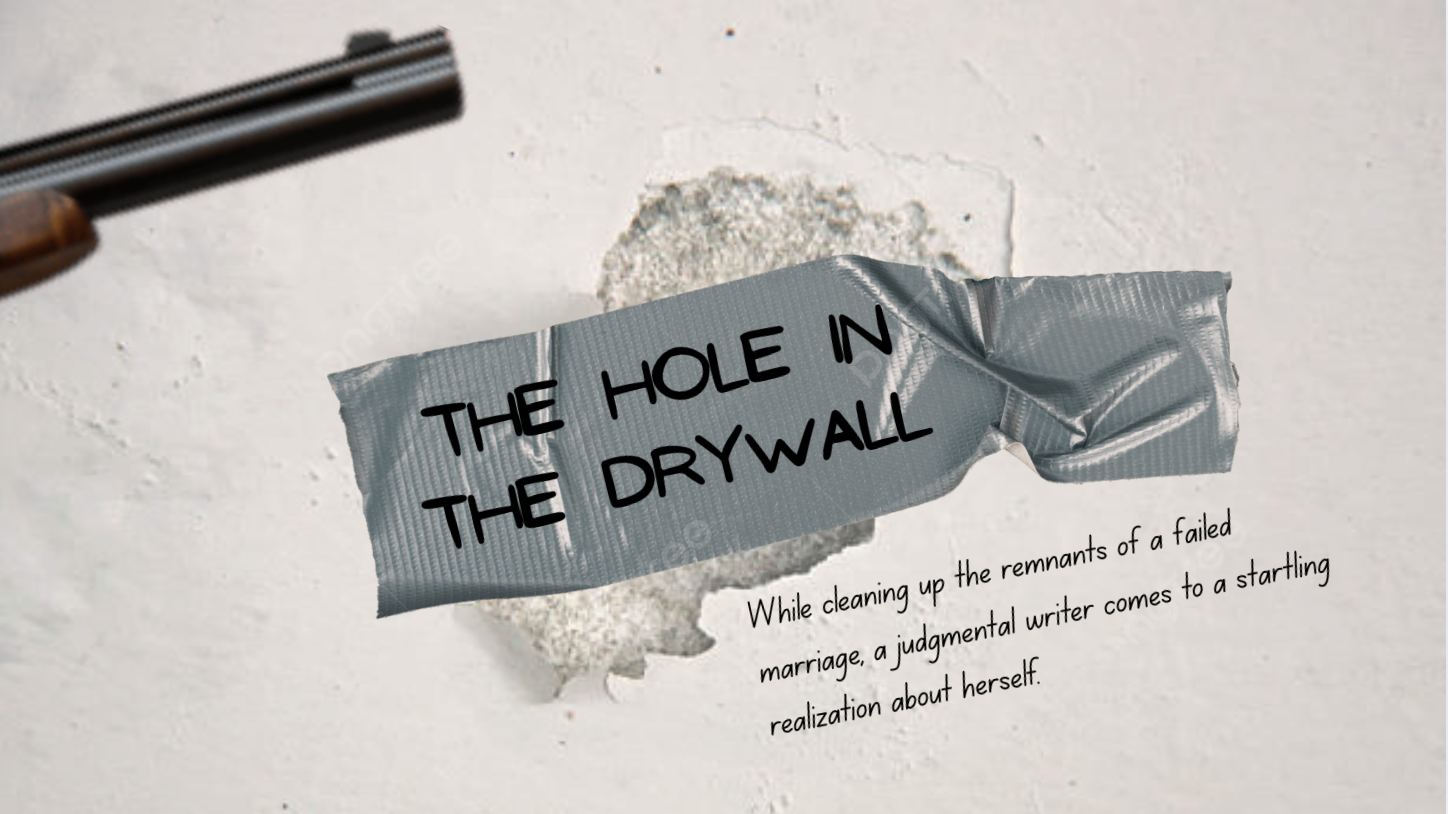
The Hole in the Drywall was initially written for a class assignment in which we imitated a classic author’s style. While my inspirations for this story were Chekov and James Joyce, I do think it ended up retaining a lot of my personal voice and style. I was inspired by the idea of Chekov’s gun as the story itself, and also a character who, despite having an epiphany by the end of the story, still does not know themselves to the fullest extent. This is where Alma, the judgmental and self-righteous - yet still deeply flawed - character comes from. I really enjoyed inhabiting Alma’s mind and the way she sees the world, and found a lot to love in Oscar, too, even though Alma thinks very little of him. This is one of my favorite stories that I’ve written to date.
Read The Hole in the Drywall here:
It was in the midst of packing up the pool house that the anger began to creep in, an incessant irritation which tiptoed along Alma’s skin like static electricity. When she had first married Oscar, she had moved in with grand designs of transforming the pool house from drab storage into an unspecified craft room for her nebulous un-started aspirational hobbies, but not long into the fall Oscar told her he planned to use the space to store his hunting supplies, and so she had set herself to the task of building him shelves and wall mounts and forced her private sanctuary from her mind.
And now, the irony: cleaning up the pool house had been assigned to her, because Oscar was too busy.
Alma took satisfaction in Oscar selling the house. Over time she had wondered, more than once, whether he had ultimately proposed to her because marriage meant them moving in together, which meant a shared burden for the mortgage. Alma knew his previous wife had more money than Oscar did. She knew she, herself, had more money than he did. She would be taking all of this money with her, as well as, it seemed, the house – for even though the house was being sold, with the money going to Oscar directly, their divorce was the reason it would no longer belong to him and that simple fact would mean Alma and the loss of his three-story colonial would always be inextricably linked in Oscar’s mind.
There was very little in the pool house that belonged to Alma. Her possessions were meagerly piled by the double doors, thrown open. Oscar’s boxes – she could not muster her spite to pack them messily, it was too against her principles – were stacked along the back wall, along with the numerous artifacts, too big to be boxed, from the walls.
One of these was Oscar’s father’s prize hunting gun, which Alma remembered being mentioned in conversation once or twice during their marriage. It was a pre-64 Winchester Model 70, “one of the best sporting rifles in the world,” Oscar said, “that Dad won off a professional elk hunter in a poker game in Maine.” Whether or not the story was apocryphal, Alma never much cared. She was scared of guns. Her older sister, a teacher in Florida, talked incessantly about guns, and children and guns, and guns in schools, and whether or not teachers would be required to carry guns in the near future, for the safety of the children. Up here, guns were not as common. Only the men who really liked to hunt, and even that as an ambitious hobby rather than any regular activity they actually enjoyed, kept them. Some had them as heirlooms. Oscar was in both groups proudly.
The mid-day sun was hot through the pool house’s thin glass windows. Alma dropped her dusting rags and sat in the middle of the room. She was sticky with sweat and the discomfort that came from being among the possessions of a person one didn’t really like. For no reason she could rationally pinpoint, she reached for the Winchester Model 70 and pulled it into her lap.
The whole contraption was long, heavier than expected. The barrel jutted out from the nestle of Alma’s lap. The wood grain was smooth. A few chips betrayed its use. The scope was made of cold black metal and the intricacies of it were unfamiliar, impenetrable. The only element Alma recognized was the slim metal trigger underneath the gun’s body. This was familiar to anyone, she thought. Her eyes traced the scope until she found the small metal latch of the safety, which she turned to the off position. The gun made a click. For figuring this out, she was proud of herself.
It was while she was sitting on the concrete floor, the Winchester in her lap, that Oscar’s shape filled the doorway of the pool house. He was a large, bulky man, and when he stepped into the path of the sun he blocked it. The room darkened aptly with his presence. Alma looked up.
“I’m here for the leaf blower,” the faceless darkness that purported to be Oscar said, and then, “what are you holding?”
Alma lifted the Winchester so he could get a better look.
“What are you doing with that?”
She wasn’t sure, so she shrugged.
“It’s my dad’s gun.” Oscar left the shadow of the doorway and stood over Alma, looking down on
her with a face twisted into derision. “Pretty sure he left it to me in his will.”
“You can have it,” Alma said then, and held up the gun to him, even though her chest tugged and
disagreed. She liked the gun in her lap; she liked its weight. In the years they had been married, she did not think she had seen Oscar hold the gun even once, or even touch it, even take it down from its rusted metal hooks on the pool house wall. Perhaps Alma had been the first person to touch this gun in a long, long time. She liked that idea.
Oscar took it from her now, and left her hands empty. He hefted its weight but seemed not to know how to hold it, as if he had never once shot a rifle – though Alma knew he had, on his near-monthly hunting trips with old college friends. The rifle didn’t suit him very much and she wanted it back.
“I was going to put it with your things,” she said, and reached for it again, lightly grasping the handle. Oscar looked up with a shade of offense.
“Well, I have it now.”
“Are you taking it with you now?”
“Well, no.”
“Then let me put it with your things.” Alma gave a gentle tug. When Oscar pulled back – she hadn’t
been expecting that – she dropped her hand and stood up so she could look him in the eye. They were the same height, which was why he had never hung a single photo of them together in his house, and perhaps that should have told Alma everything about him she needed to know.
“Why should you get to have it?” Oscar frowned like a hurt puppy.
“I’m not taking it,” Alma said, though she was, “I’m just putting it with your other things, and when you come to get them you can have it. What do you need with this gun, right now?”
“What do you need with it?”
“I’m not taking it,” she said again, in a thinner voice than before, hoping he would leave, hoping she would have the pool house to herself again. “It’s your father’s gun.”
“Exactly.”
“So why would I take it?”
“You’re not a gun type-of-woman, anyway,” Oscar shot back with his free arm crossed over his
chest. Alma wondered what a “gun type-of-woman” was and how a regular woman became one, whether you had to be born into the right.
“You hated your father,” she said very suddenly, and before she could take it back, Oscar was recoiling as if the words had struck him physically. His thick eyebrows furrowed; his forehead creased.
“What does that have to do with anything?”
“If you hated your father, what do you plan to do with his gun?”
“It’s a very good gun,” Oscar said, as if that explained it all. He still held the barrel upright, but
looser now; Alma reached forward and pulled the gun from him. She examined it with an untrained eye but she hoped she looked like she knew exactly what she was doing. Perhaps it would entice him to let her have the gun. She could not remember when she had started wanting the gun. “And for the record,” Oscar added, watching her, “I didn’t hate my father. He hated me.”
“Is there much of a difference?”
“Of course there is,” he sighed heavily. He had become used to speaking to her this way, like she was a child. It made her stomach clench in annoyance. “Didn’t I tell you, when I was twelve years old, he tried to kill me with that gun?”
Alma vaguely remembered such a story. He had told it so long ago that it didn’t have much meaning to her anymore, not that it had in the first place, because there was something about Oscar telling a sob story from his childhood which was singularly humorous. She knew, however, whether or not she remembered it, Oscar would be telling her again anyway. She sighed and shifted the weight of the gun from her lower arms to her shoulders. Oscar reclined against the door jamb, his posture relaxed, slipping into storytelling mode.
“I was twelve years old. I failed tryouts for the football team. I wanted to go for soccer, but my father said it wasn’t enough. It was the last time I argued with him, because when I tried, he took the gun off the wall – this was when the gun was still in his office – and pointed it right at my forehead.” He punctuated each word with a stab direct to the center of his cranium. “It wasn’t loaded, but I wouldn’t have known. And since that day I never said a thing against him. Not a thing.”
“So brave,” Alma said under her breath, and knew Oscar had heard her anyway, because he scoffed. “All I’m saying is, I’ve got a reason to keep the gun. It’s my father’s gun.”
“I never said you couldn’t have the gun.” Alma was more disinclined to give him the gun by the
minute.
“Well, why do you want it?”
“It’s nice,” she answered before she could think better of herself. “It’s a good... antique. I think it’s interesting. Maybe I could write about it.”
“You don’t need to have it to write about it. You could’ve been writing about it all this time and you never have.” Oscar dished out reasoning with dizzying speed, as if he’d already had all the answers prepared. “What could you write about it?”
“Time. The passage of time.” That was not a very good answer. That was what Alma had told her agent that her next novel was going to be about, the novel which was as of yet a blank document and a blinking cursor on a neatly labeled thumb drive. She had been busy with the divorce, she told herself.
She had a sudden vision of herself, sitting in the pool house with a typewriter. A typewriter, and a fresh stack of paper and lots of extra ink. Writing a book, chapter by chapter, without thinking about it, and all the while looking at that gun, hung on the wall hooks of the pool house, telling her some sort of story that the her in her mind might be able to translate into words. “This gun,” she said, and lifted it, “is the passage of time. It starts at the handle-”
“The stock,” Oscar sighed with exaggerated annoyance.
“It starts at the stock and it ends at the barrel. Where it all blows up in your face.”
“Cheery.”
“Sure.” Alma balanced the handle – the stock – against her foot and pointed the barrel at the ceiling. “It sounds like you’re making this up on the spot, you know,” Oscar murmured, distractedly. He
had caught sight of an old antique map of the town, which was Oscar’s hometown, which Alma had painstakingly hung on the wall in a gold frame less than a year ago. The frame had accumulated dust and now leaned against the wall by Oscar’s boxes. He brushed his fingers against it. He turned back towards her, towards the gun.
Oscar scoffed again. The sight had freshly offended him. “How does it matter to you, at all?”
“Things can be important to me without you understanding.” Isn’t that what all of this was about, after all?
That must have been it for Oscar, those words that set off that invisible trigger inside him, the trigger that men had that made them capable of violence. He propelled from the wall and in seconds he was standing in front of her with his big meaty fist closed around the barrel of the gun. He gave it a tug which was not quite enough to wrench Alma off her feet; instead, her hand slipped against the smooth wood of the stock, skin squeaking slightly, and her pointer and middle fingers nestled against the trigger of the gun, the metal cool, inches away from the propulsive mechanism of slim quick destruction. The barrel of the gun was between her and Oscar’s hulking shoulders, his reddened face.
He was like a picture of a man she’d never met. She regarded him for the first time – really, for the first time – all the parts of him. His thick flesh below his wool sweater, fat masquerading as muscle. The stubble on his chin and jaw that sprinkled up onto his cheeks, a shade or two lighter than the hair in his nose and ears that he always forgot to trim. The splotches of pink that blossomed when he dared to show any emotion. He had thick eyebrows and they were always pointed inwards in consternation. Alma remembered that when they had first started seeing each other, she had likened him to a daguerreotype or a vintage stamp, something old, something depicting a lumberjack. Oscar had been all too happy to play into her ideas and wore flannel shirts and knit hats until the weather warmed and he got bored of the idea, and then he had gone back to Merino wool and khakis, looking like a linebacker that had played dress-up and gotten stuck.
“Let go of it,” Oscar said, some spit flying from the corners of his lips.
Why should I, Alma thought stubbornly, why shouldn’t you let go of the stupid gun that your stupid father almost killed you with? The gun he hung in the pool house, that he didn’t even look at every day, the gun that was the passage of time and ended in sheer destruction that he’d never thought to think about? Why should all of the tragedy belong to him?
“Let go of it,” Oscar insisted. His voice was angry, loud. Without quite realizing she was doing it, Alma put all the pressure in her chest in her pointer and middle fingers, resting on the trigger of the gun. She pressed downwards.
The gun was loaded, she realized very suddenly, when a shell exploded in firey black powder from the end of the barrel, just in front of her face, and Oscar’s face, aligned. Both of them fell back from the force of the blast, the gun dropping between them. Alma’s face felt hot, scorching, really, and when she touched her skin it stung. Oscar had landed hard on his back. The shell went through the ceiling and left a pinprick of a hole that light came through. White dust, drywall and plaster, rained down on Alma’s hair. It stuck to the sweat on her forehead.
Her ears rang and rang with seemingly no end in sight, and Alma remembered that someone had once said to always wear ear protection while firing a rifle, and for good reason, it seemed. She glanced over and saw Oscar had a red, irritated mark on his face, a burn already beginning to scar. She became aware of a pain in her abdomen, a bruising, maybe from the recoil of the stock slamming into her as they dropped the gun. Both, at the same time, dropped the gun, at the same time.
Alma stood up, dusted off her knees, and left Oscar on the floor of the pool house. She had nothing to say to him at that exact moment, and wouldn’t be able to hear if he replied. She drove herself to the hospital and was diagnosed with mild bruising and temporary hearing loss. She lied to the doctor and said she had lost her footing and hit her head on a railing. She was told she was lucky.
Alma did not regain her hearing for another six hours, and it was tinny at best for a few days. Oscar texted on the second day and informed her he had finished cleaning the pool house, and her things were
waiting in the driveway for her whenever she wanted to pick them up, but she should do it soon, because it was going to rain. He also said that he would have to hire someone to fix the hole in the ceiling, and he hoped no one else had heard the noise, because he wasn’t in any state to talk to the police. It was the last they spoke of it.
In the end, none of Oscar’s neighbors came calling after the unexplained gunshot, and the crumbling hole in the drywall never appeared in the lengthy court proceedings. Tinny hearing righted itself; time went on from the stock to the barrel and into the gaping unknown. The only thing which kept that afternoon fixed in Alma’s mind, lodged like a bullet, was the frank and confusing knowledge that she had become the type of person willing to pull the trigger on an antique shotgun when provoked.