The Red Eyes
An author with the ability to see ghosts avoids the funeral of her little brother who drowned in a freak accident. Her plans are disrupted when his spirit visits her, unwilling to move on.
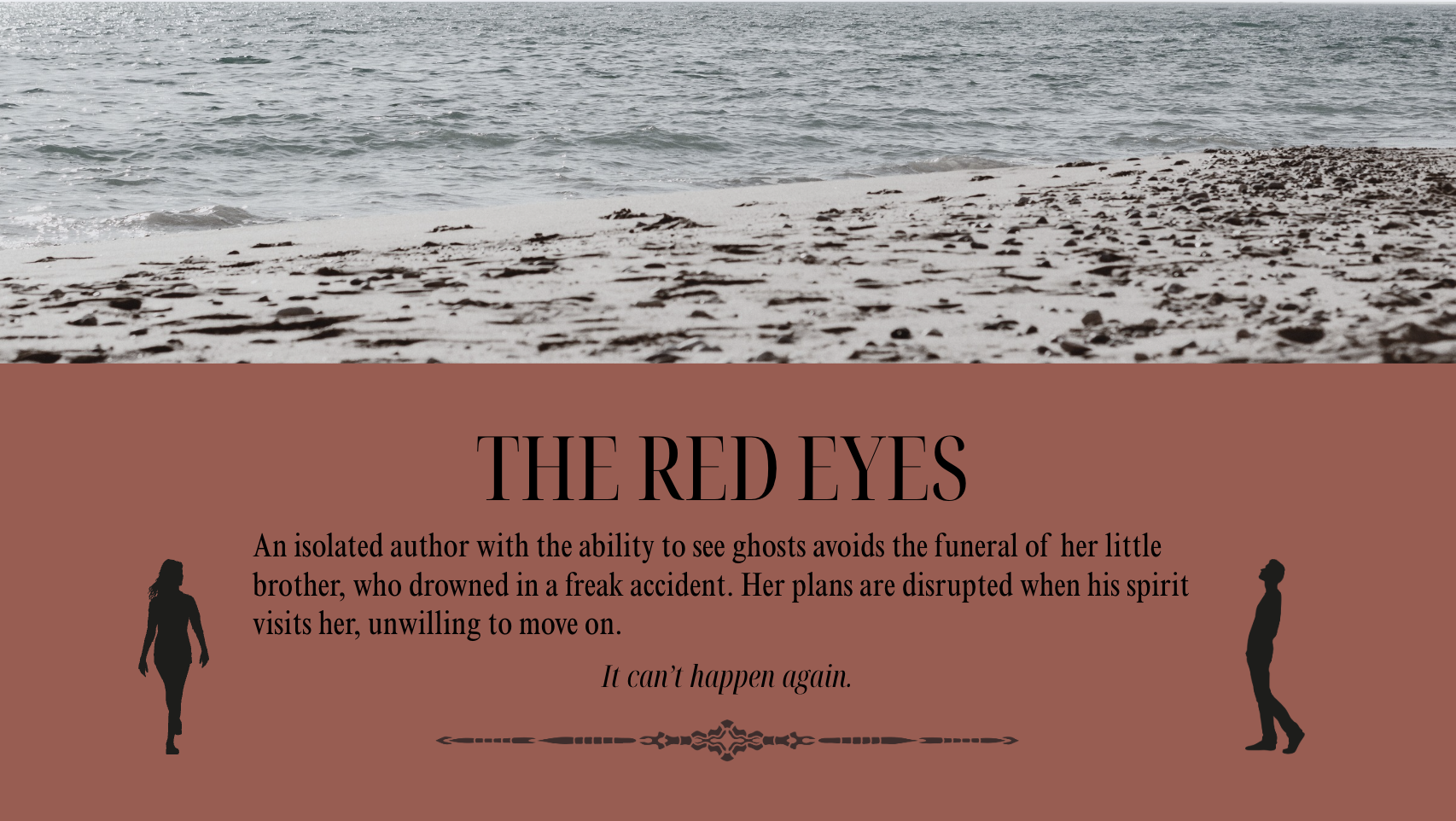
The Red Eyes is a short story about ghosts, grief, and responsibility. I first conceived of it a few years ago, and it went through many drafts, including a stint as a nonlinear experimental narrative, before I realized that the concept — both the message and the style — reminded me of an Edgar Allen Poe story. After rewriting in an evocation of Poe’s style, I was able to find the heart of the piece, which lies in Hettie’s relationship with death and fear of self-reflection. These themes are evident in Poe’s writing from The Tell-Tale Heart to The Black Cat, and it was something I was interested in exploring here. I enjoyed the chance to write in a style that was unfamiliar to me and explore this idea and these characters.
Read The Red Eyes here:
I was raised by a small, honorable family on the northern edge of a town called Keeper’s Quarry, Maine. The house I grew up in had been held in my family for generations. Each of my siblings and I were christened with names which had some familial significance – my elder brother John Jackson, for our great-grandfather who had settled the family in Keeper’s Quarry and I as Henrietta Jackson, for his wife – although everyone called us Jacko and Hettie. My younger brother Isaac was named for our uncle, who had died fighting a meaningless war overseas. My parents like to say that Isaac came out kicking and screaming, and that he would go out just the same way.
A spirited childhood was shared between my brothers and I. We spent much time on the wharfs and the beach, collecting seashells and polished stones and playing mermaids at low tide. It was not until my seventh birthday that I began to grow inexorably and unavoidably apart from them.
A number of days before I would turn seven, my grandmother Rose-Anne passed away in her sleep. They declared it peaceful and told me, a child with little notion of death at the time, that she had been tired for a long while. I understand now that my grandmother had been sick, not of the heart or the lungs, but of her mind. Perhaps her condition was related to the affliction in myself which I was soon to discover, that upon further reflection of my childhood must have also been possessed by my grandmother. I would learn in the coming years that my peculiar talent ran in the family and was simply a manifestation of an illness which had been present among us Jacksons since our family had arrived in Maine. Maybe it was something in the air.
The unfortunate timing of my grandmother’s passing led to the scheduling of her funeral on the same day as my seventh birthday, with a wake to follow in her large homestead on the outskirts of Keeper’s Quarry. In my youngest years, my brothers and I had spent much time in this house, whiling away long weekends traversing the rocky hills of the backyard and building monuments to our imaginations on the ocean cliffs. After my grandmother’s death, the towering black columns on the porch seemed more imposing. Isaac, who was but four at the time, whined and cried so loudly he had to be taken back to the car and in fact never set foot in the house on the day of my grandmother’s wake.
As a small girl, selfish and forced to sacrifice her birthday to the odd mourning rituals of the still-living, I sat at the funeral with a look of dreaded anger on my face, kicking my feet repeatedly against the chair in front of me in defiance. But upon taking in that great house — the black curtains drawn over the windows and the yawning door thrown open — a childhood paradise, a foreign kingdom to explore, turned into a bitter mystery. The stale air of it melted unpleasantly on my tongue. I could taste the death in the air; a part of me knew that without the presence of my grandmother, or whatever she had carried with her, the house had changed.
But what confused me endlessly was that my grandmother was still there. As I was led from room to room, introduced to older relatives who remarked on my growth and maturity for my age, I could see her, peeking around corners and gesturing for me to come nearer. Every time I tried to free myself from my father’s iron grip on my hand, he only tightened it. I saw no more than glimpses of my deceased grandmother at that wake; although, long after I was tucked into my bed in my own room that night, an uncommonly fierce wind off the ocean shaking the panes of my windows, I hold a distinct memory of waking to a large black shape blocking out all the light, which later leaned down and kissed me on the forehead, and it felt like nothing at all.
And thusly, I was afflicted. It seemed that wherever death went, a residue seemed to follow, transcending what anyone around me could see.
I remained through adolescence a rather odd child, with a fondness for poetry and obscure animals — such as crows, or snakes — that did not fit neatly with the predisposed ideas of a girl my age. I was often teased. I spent my childhood isolated, hiding in the library during lunch periods and reading about serial murderers, whose victims became like celebrities to me. In a childish way I found the gruesome fascinating, and I assumed a casualty of any of these killers would be far more interesting to observe than the sad elderly poltergeists I saw lumbering around the graveyard which lay only a block away from my elementary school, or the cancer patients who stumbled sadly out of the hospital and sat down at the bus station as if they had some appointment they might be late for. Unable to accept their place.
Due to my peculiarities, and my general lack of interest in fashion or sports, topics which endlessly fascinated my peers, my closest companions were always my brothers. Isaac, as the youngest, was incredibly dear to me, but it was Jacko with whom I felt the truest kinship. In our youngest years, we were nearly inseparable; as happens when an elder brother reaches puberty, he found other pursuits and other friends with which to waste his time, but one of my greatest pleasures was when he would put down his books or homework and spend time with me. Jacko liked to listen to my stories and, though he often spent his weekends playing soccer at the high school or hanging out at the local diner with his friends, he still made time to wander the beaches with me, skipping stones on the choppy ocean.
It was nearing my eleventh birthday when, in a turn of events dazzlingly fortuitous to my adolescent mind, Jacko’s soccer game was cancelled on the same day my parents were to drive into Portland to attend a private tour of an art museum in which they, as collectors, had a vested interest. Jacko, now fifteen, was deemed old enough to take care of both me and Isaac by himself, seeing as our usually reliable babysitter was already away at college. It was a brisk August afternoon, windy but sunny, and after dropping Isaac at a friend’s house for a playdate, Jacko and I walked down to the beach.
It was, I must note, an awful time in my town, for just recently a house fire had claimed the lives of two parents and three young children in a cabin not far from the beach which Jacko and I most frequented. For a period of about two weeks our parents had told us to steer clear of that particular piece of shore, as rubble was cleared and town services inspected the safety of the area. Deciding to take advantage of our parents’ ignorance, Jacko and I trampled the marsh grass on the rocky path down to the beach, chasing one another down the hill.
It was not long on the cool sand before I became aware of a presence not a few feet away — that of the mother who had perished in the fire, whose name I do not now remember but likely knew back then, and two of her young children. As like most ghosts, they wavered in the wind, seemingly at the whim of the natural elements. For all but their slightly transparent image, they were indistinguishable from a living creature, and in fact my biggest clue that they were not really there came from Jacko’s ignorance of their existence.
I interrupted him in his skipping of rocks to ask if he wanted to see something interesting. It should be noted that I had, at times prior to this, attempted to explain the manifestations I saw to various members of my family, to lackluster results. Isaac, of course, was too young to understand; my mother and father dismissed the tales as the fanciful ramblings of a child. Jacko seemed to have more tolerance for them, surely because he remembered a time when he might have made up such stories himself. No one really believed me, but I tried not to take it to heart, as like with the existence of God and Santa Claus, it can be hard to believe in things for which you have no visual evidence and must rely on the words of others.
Jacko obliged and turned his attention to me. I pointed in the direction of the deceased mother and her children, who in their despondence and misdirection were unaware that they had my attention. I informed him that I could see the ghosts of those who had lived in the burned out shell of a house just visible over the rise of the hill.
I saw on his face a look of barely-restrained humor as he asked me to describe her. It was clear that he did not truly believe me, and in fact was beginning to grow tired of my childish declarations. In an effort to counteract his distrust, I began to describe the woman in great detail.
“She’s wearing a pink nightgown,” I said, “with white lace on the sleeves and hem in a floral pattern. Her hair is brown and shoulder length, with bangs over her forehead, which has a small scar above the left eye. Her nails are painted red but chipped and she has no makeup on. Clutching tightly to her right hand is a small boy, near Isaac’s age, with sandy blonde hair in a bowl cut and Thomas the Tank Engine pajamas. She is holding his sister, who has a rainbow pajama set decorated with small cartoon cats. The little girl has her thumb in her mouth. Her eyes are very sad.”
Jacko seemed disturbed by my description, which I assume matched perfectly to that he had heard circulated around town in gossip of the appearance of the deceased persons at or around the time of their deaths. I saw him think for some time, and then, in the manner of a teenage boy with an underdeveloped brain and very little fear, he announced, “I want you to show me.”
I yearned for Jacko’s approval, although I had never before attempted to share with anyone else the gift of my affliction, and in fact was not even certain that it was possible. But at the time, I believed, there would be no harm in trying.
The method by which I chose to impart my affliction onto Jacko was influenced by the novels I had grown up reading and the plethora of movies I had seen as a young child which featured paranormal phenomena. I took his hands in mine, had him close his eyes, and attempted to connect our minds. I had no real conception of the effect of what I was doing, physical or mental. There was a tenuous band of energy which I could tell was connecting us, violent white and unwieldy, but I had little idea of what might happen if I, as I did, took hold of it and tugged. I was a child. I was impressionable.
When I heard Jacko scream in pain, I opened my eyes and was met with the sight of my brother curled in a fetal position on the ground. He moaned and cried out for help. When he opened his eyes to reach out to me, I saw that they were nothing but white. I ran for the nearest neighbors, and when I returned, Jacko’s pain had not lessened — moreover, the ghosts from the burned house seemed to be gone.
A visit to the hospital deemed Jacko permanently blind, although no doctor was able to determine how it had happened. We lied and said that he had fainted and woken up like this, leading them to believe it was an injury of the brain. To our parents, we were truthful, although neither of them believed our tall tale. We were playing too hard, they said, and blamed me for not being careful and Jacko for not paying more attention to me. Though the exact cause of Jacko’s blindness was never decided on, and would be a constant topic of debate for many years, one thing seemed consistent: I was to blame.
After the accident, I tried desperately to represent to my parents what I saw, and that these paranormal manifestations were not simply the imaginings of a childish brain. These continued protests led only to my parents’ steadfast belief in my mental illness, and when I was twelve years old my parents admitted me to a clinic in western Vermont that specialized in taking care of children with what they described as “delusions.”
My time in various care facilities did not end at this particular institution, and it did not improve, either. I was subjected to therapies at various points which ranged from the pointless to the painful. My parents, though they cared for me deeply, saw my unwillingness to admit to my own illness as a symptom of the problem and became increasingly concerned about my functional health. The stress of dealing with me, I suppose, drove my parents to the brink time and again and resulted in them seeking out a divorce when I was in my early teens.
Throughout my tumultuous pubescent years — some of them spent at home, some in various institutions — I did not speak much with Jacko, who avoided me as much as possible and, I think, was quite relieved when he received the chance to attend college on the other side of the country. Over time, his memory of the accident which had claimed his sight altered irrevocably — he no longer remembered the ghosts, or whatever he might have seen in those brief moments when my own abilities were possessed by him. He remembered only that I had played a cruel prank which had changed his life, and that I had not given up insisting that it was real.
Isaac, in the meantime, was abandoned in the crossfire of my relationship with both my parents and Jacko. He grew up overshadowed by my and Jacko’s needs, his accomplishments always coming in third. Almost as soon as he received his learner’s permit, he was enlisted to ferry me to doctors, appointments, and out-patient programs. Any ill will he bared towards me because of this was buried convincingly beneath his genial demeanor, though many times I caused him to miss a school event or trip out with his friends because of my condition. Isaac had incredible strength and a playful manner which made it hard for much to visibly affect him; he cared more for others, I often believed, than he did for himself. He seemed happy to take care of me, which only made me resent the care more; it all felt so useless.
Upon reaching my nineteenth birthday, I ended my therapeutic care and departed abruptly for New York City, where I harbored dreams of becoming a writer. They were unfortunately soon dashed. I couldn’t find work, I lived in poor housing, and I was beset with murmuring whispers and desperate spirits on every corner. New York City is full of ghosts, and all of them are loud, and none of them are very kind — this, in addition to all the other things that make New York City difficult to live in, made my time there quite the living hell. After less than a year I moved to the upstate town of New Warwick, which I found much more agreeable. The small hamlet was just the right size, and the people were friendly. It was a new place without quite so much history.
I rented a house with a young woman named Mel, who was an executive assistant at a paper company but spent her free time attending seances and hobnobbing with the New Warwick spiritual community. She was the first living person I had met, and understood, with the same affliction as me, and embraced me warmly as a wandering soul. Mel had a comforting presence that could not be understated; she had spent her childhood traveling the country with her elder sister and grandmother, following ghosts and recording their stories, and now continued the practice here in New Warwick. It was her special talent to get people to open up to her, and it worked wonders on me, who had been locked up inside herself for so long.
It was Mel who first encouraged me to write down the stories of those ghosts I encountered. I seemed to attract a certain kind of spirit; those who had been abandoned in life and now, in death, sought to rectify their own loneliness. In this manner, I heard many stories whispered into my ear in the darkness, of lovers leaving and children dying and friends betraying, and in the morning, I took note of them in a series of small locked diaries I kept in my bedside table. The pages thick with cramped, slanted writing, I would every so often remove them to read the half-conscious ramblings of the dead, and it dawned on me eventually that they would make wonderful stories.
I had been living off of my meager savings for too long, and with my resources dwindling I purchased a train ticket into the city and spent an agonizing week traveling from publisher to publisher, attempting to sell my hastily written stories. I am sure it was not the style of such compositions that intrigued them, as I had little time to prepare and had done most of the writing by the light of a single lamp in the dead of night, but many expressed interest in the complex and emotionally fraught dramas which I had penned. In some cases, they made suggestions to increase the melodrama even more, which I embraced as I intuited that listening to their advice might bring me success. In the end, though I suffered a long seven days of bombardment by the anxious, angry dead, I secured a six-year deal with an independent publishing company to write a series of short stories which would later be turned into anthologies and dime store novels. It was not the luxurious career I had once dreamed of, but it was fulfilling in its own right, and I was in no position to turn down the money.
Mel and I went about our lives; we invited in the ghosts, who spoke to us and shared with us their regrets, which we did our best to rectify. It was not unlike the stories you read now, of kindly mediums who channel the wishes of the spirits beyond, and really to write about it here makes it seem almost insignificant, compared to what would come later. But neither Mel nor I felt the need to accomplish more than what we already had. We had both had tumultuous childhoods and appreciated the chance to settle down; I quite liked knowing, when I woke up, that every day would be the same.
For a handful of years, I lived in New Warwick in tranquility. My lighthearted, if not entirely carefree, life was interrupted abruptly on a November afternoon by a call from my mother, who informed me that my brother Isaac had passed away in an accident that morning.
Isaac had been living in California, not far from where Jacko — and later Isaac himself — had attended college. He was working as a software engineer and had an avid surfing habit. Each morning during the season he would drive to a small public beach where he knew the waves were best and spend the early morning hours embedded in the ocean. It brought him joy, to exist only for himself in those moments.
On that cold fall morning, Isaac had taken a chance that a potentially incoming storm would not impact the waves and had gambled poorly. He was caught in a rip which pulled him out to sea and tossed him back in so roughly that his body broke against the shore; the water filled his lungs just so that when he washed up against the sand the locals who found his body were unable to pump it out of him. He was declared dead by the EMTs not long after their arrival; my mother called me once she had been notified.
Isaac’s funeral was scheduled for three days after I received the news of his death. Though it was assumed by all of my family that I would be in attendance, the morning of his funeral dawned and I still had not made a decision as to whether or not I would take the train to Keeper’s Quarry. I chalk it up now to indecision mixed disastrously with fear, though at the time I found the choice difficult for entirely practical reasons: work, my responsibilities at homes, and my distance from my family. As luck would have it, the local line was shut down for the day for repairs, and so it seemed I would never have been able to make it to the funeral in time anyway.
Isaac was the first of my close relatives to die since my grandmother, and a curious sickness consumed me in those days after his death which seemed a product of both my grief and my fear at seeing his spectral form lingering around the funeral like some sort of bad omen. I found myself wracked with sobs at odd times and enduring constant pain which was not eased by hot water bottles brought to me by Mel or simply lying in darkness, as I often did when I had headaches. Isaac’s countenance haunted me. I did not know what his face looked like in death; I knew that I might soon find out.
On the morning of the funeral, I went about my routine as if nothing was happening, all the while feeling those intense stomach pains I had been having since my brother’s death. I intended to get some work done at the local library, which had a beautiful reading room that was sure to get my mind off of the day’s dreary subject, but I was instead hounded with phone calls from my mother and Jacko, relentlessly questioning my absence. I attempted to make excuses about work, but they would hear none of it.
That which I had been dreading occurred finally when I had avoided my family’s calls and managed to meet with Mel for coffee. I must state that ghosts, contrary to popular belief, are not necessarily tethered to any singular location. Rather, they tend to find themselves drifting through the world in connection to that which was important to them in life; maybe a house, but more often, a spouse, a friend, perhaps an object which held some special reverence. I had thought that by avoiding my brother’s funeral I would therefore avoid his spirit, for surely Keeper’s Quarry was where Isaac would find the most attachment to his physical life. My surprise compounded greatly when I noticed him following me down the main street of New Warwick, and thus realized that that physical component to which he ascribed the most attachment was, remarkably, me.
I was hardly able to put off speaking to my brother, who lurked menacingly behind coffee shop patrons while Mel and I conversed. Though it took her much longer to become aware of his presence, Mel eventually realized what exactly was making me so jumpy and very kindly gave me and Isaac space, retreating to an outdoor table to watch over me if the need for intervention arose.
The best way to speak to a ghost in public is to make it appear as if you are on a phone call; this method does not attract the unwanted attention of passersby who believe you might be talking to yourself, and therefore slightly crazy. I feigned receiving a phone call as Isaac approached me, but this show did not deter him.
He stood before me in a wetsuit dripping phantom water, his eyes a mixture of fury and grief. I wished in that moment that I had more words to comfort him with, but all I could manage to say was “hello, Isaac.”
The words we exchanged in this first encounter have mostly faded from recollection, as the combination of adrenaline and regret coursing through my body rendered my mind incapable of capturing any particular memory. I remember that he asked a thousand questions, to which I could provide only some of the answers. When he was young, and I was his peculiarly absent older sister, Isaac had seen my so-called illness as something mysterious and taboo, but now that he was living in its truth he wanted detail, and a lot of it. It was gruesome to tell him. The things that kept me up at night, the harsh truth of the loneliness brought about by my affliction.
Isaac requested that he spend some time alone, and asked me if it was possible to return later to speak again. I informed him that until he made the deliberate choice to move on, he would always remain here, among the living but not within them, wandering lost.
“So I can stay?” He said it with an air of such hopefulness that it almost broke my heart to tell him the truth.
“You have to let go of what haunts you,” I told him. “Otherwise, you will always be in between. Unless you choose to move on, you will remain here. But-” and here I hesitated, for what I had to say next would be like a second, more painful blow to my brother’s lungs. “If you refuse to look at that which haunts you, the pain you feel or the pain you caused, it will take control of you. It will anger you so that it consumes you, and your soul, your very being, will fade until all that is left of you is a destructive shell. We tell these ghosts apart by their red eyes.”
“That sounds very dramatic,” Isaac joked, but I did not share his smile.
“It sounds so, but you wouldn’t believe the number of spirits I’ve seen turn out this way.” I folded my hands behind my back, reaching into my waistband to retrieve the single item which I never left the house without. I presented to Isaac a slim knife, easy to disguise and about the length of a fountain pen. It was simple, wood-handled, but held an indefinite weight. “When a ghost becomes consumed by anger — becomes dangerous — it is my job, or the job of those like me, to... take care of it.”
“You kill them,” Isaac said with such offense.
“They’re already dead,” I reminded him. “But I — we — separate their souls so that they cannot return to cause harm to those they hold grudges against. We force them off of this plane.”
Isaac regarded the knife with concern. I saw a wavering in his eyes, an eroding of trust. Slowly, I returned the knife to its place beneath my clothes, hidden from prying eyes.
Despite his apprehension, Isaac did promise to find me again, and we separated. I returned to Mel with sobs shaking my body, and she held me there in the middle of Main Street as I cried.
I spent the rest of the day unsure of how to proceed. I knew that Isaac would return, but I did not know how long it would take him, nor what he would be like when he did. I attempted to live life as normal, eating dinner and watching the nighttime news with Mel, but around every corner lingered an invisible presence, an anticipation. I wondered if I finally understood the way the rest of the world went about their lives; never sure if something was watching them from beyond the veil, but aware of its presence always, constantly.
I attempted to retire to bed after dinner, but told Mel to keep an eye on me if she was able. She promised to keep our bedroom doors both open — her room was right across from mine — and if I seemed like I might need help, she would come for me. I thanked her profusely before separating for the night. It does little good, these days, to remind myself that Mel was the best and closest friend I had ever had.
The moon was high in the sky when Isaac finally found me. I had kept myself awake by reading in bed, unwilling to sleep until I was sure he was not coming that night, and my vigilance had, it seemed, paid off. He appeared in my bedroom from the shadows, coalescing out of nothing, and requested that we take a walk.
The neighborhood was quiet, dark. Isaac walked beside me, and when our arms brushed I felt as if the sea was crashing into me, filling my lungs. It was a quietly unpleasant sensation, but I swallowed it down and did not let Isaac move further away from me. Finally, he broached the topic of conversation that I knew he had been wanting to ask all day, but which his anger had prevented him from pursuing.
“What’s after this, then?”
I had the unpleasant duty of admitting to him that I did not know. Though I spoke frequently to ghosts who had suffered all sorts of horrors of death, the most that they remembered was the world going black around them before it turned hazy with recollection and they entered the state they were in when I encountered them. There did not seem to be any way to find out what happened to a ghost after they passed, as they would then enter a realm, supposedly, that I could not reach. Or, I said to him sullenly, perhaps the cynics were right; perhaps he really would just cease to exist.
“How would I trigger that change?” Isaac was impatient, as he always was in life, desperate to have the answers and to enact solutions as soon as possible. “How do I move on?”
I told him again that it was his choice, but he had to first be aware of what was troubling him. “Some ghosts, even after processing what is keeping them tethered here, choose to stay. They mentor the young ones or maintain relationships with people like me. Others pass almost immediately, desperate for whatever is next.”
We circled the block twice in silence before Isaac declared that he knew what had held him back from passing on to the next realm of existence. “It was confusion,” he declared. “I spent so much of my childhood stuck in the conflict between you and Jacko, Mom and Dad. I was too young to understand what was going on, only that I had been born into a family too broken to function. I sacrificed all that I could so that I could be seen, and it never really worked. And isn’t it ironic,” he asked me, “that after I’m dead, you’re the only one who can see me at all? When you never did, when I was alive?”
“I don’t know what you mean,” I told him forlornly. “You were always important to me, Isaac.”
It was at this point that I became aware of a set of footsteps trailing behind us. Though I turned us down a smaller road in the hopes to avoid whoever was following us, they unfortunately continued. A late-night dog walker, I convinced myself, and tuned them out so I could focus on my brother and the painful eyes he wouldn’t remove from me.
“I don’t believe that you ever really cared about me.” Isaac’s words were cutting, a knife between my ribs. His body wavered in the streetlights like an incorporeal vision. “You only see what you want to see. Your problem, Hettie, is that you’re too in your own head — or preoccupied with the dead — to see the people around you until it’s too late.”
A rushing of white noise filled my ears. I did not want to consider that what Isaac had said could be true, not after I had spent my entire life living within the scope of one lonely, dreary narrative. Instead, I turned on him.
Still in my day clothes as I was, my knife, that grisly tool, was strapped to my waist beneath my jacket. It was my anger — indeed, my hurt at what Isaac had so easily declared — that led me to draw that blade presently.
“Isn’t that so like you,” he said, when he saw the metal glinting off of the streetlights, casting an ominous shadow on the sidewalk. “To kill your problems, rather than acknowledge them. You’re still running away.”
An anger so white-hot possessed me that I rushed into Isaac, grasping his shoulder with one hand and sinking the knife into his chest as his eyes turned blindingly white. “You’re broken, older sister,” he spit in my face, and it took me many long moments to register that he had not become enraged, as I had believed, but instead passed his anger into me and in doing so had freed himself from his earthly burdens. My brother had passed peacefully into whatever came next.
So who, then, had I stabbed?
The answer came as I wet my hands with her blood, staring into the shocked face of my dear friend Mel. It became clear at once — that Mel had seen me leave the house with Isaac and followed me to make sure I was safe, that it was her footsteps I had heard behind us. She must have seen our confrontation and approached at exactly the wrong time, leading me to stab her so mercilessly, believing her to be Isaac. My anger, my transplanted rage and regret, had blinded me. For once, I could not see at all.
Mel gasped in my arms, blood filling her mouth and staining her teeth. She was not able to say much, beyond my name in a desperate whisper, before she lost consciousness — it was not long after that the police arrived with an ambulance to take away her body and remove me to the local precinct. The incident had been all too clear to the family living in the house across the street from where Isaac and I had paused in our wandering. I had been speaking to the air, and when an innocent young woman had approached to check on me, I had stabbed her with surety in the lungs.
I write this now from a room in a facility for violent psychiatric patients, in which I was placed after the reveal of my medical record in court allowed my state-assigned attorney to push for a verdict of mental insanity. I did not argue. I put this story down in writing so that any who find it know the truth of what happened, even if it is not believed, and so that one day my family, and perhaps even Mel’s, long gone as they are, can know what lives inside of me. My affliction is not a supernatural sight, but a curse — a gravity well — of rage and selfish indifference, which has claimed a livelihood and a life, and heaven forbid, may surely claim even more.