There’s Something Tragic About You
A ghost haunts a recent widow and begins to fall in love with her.
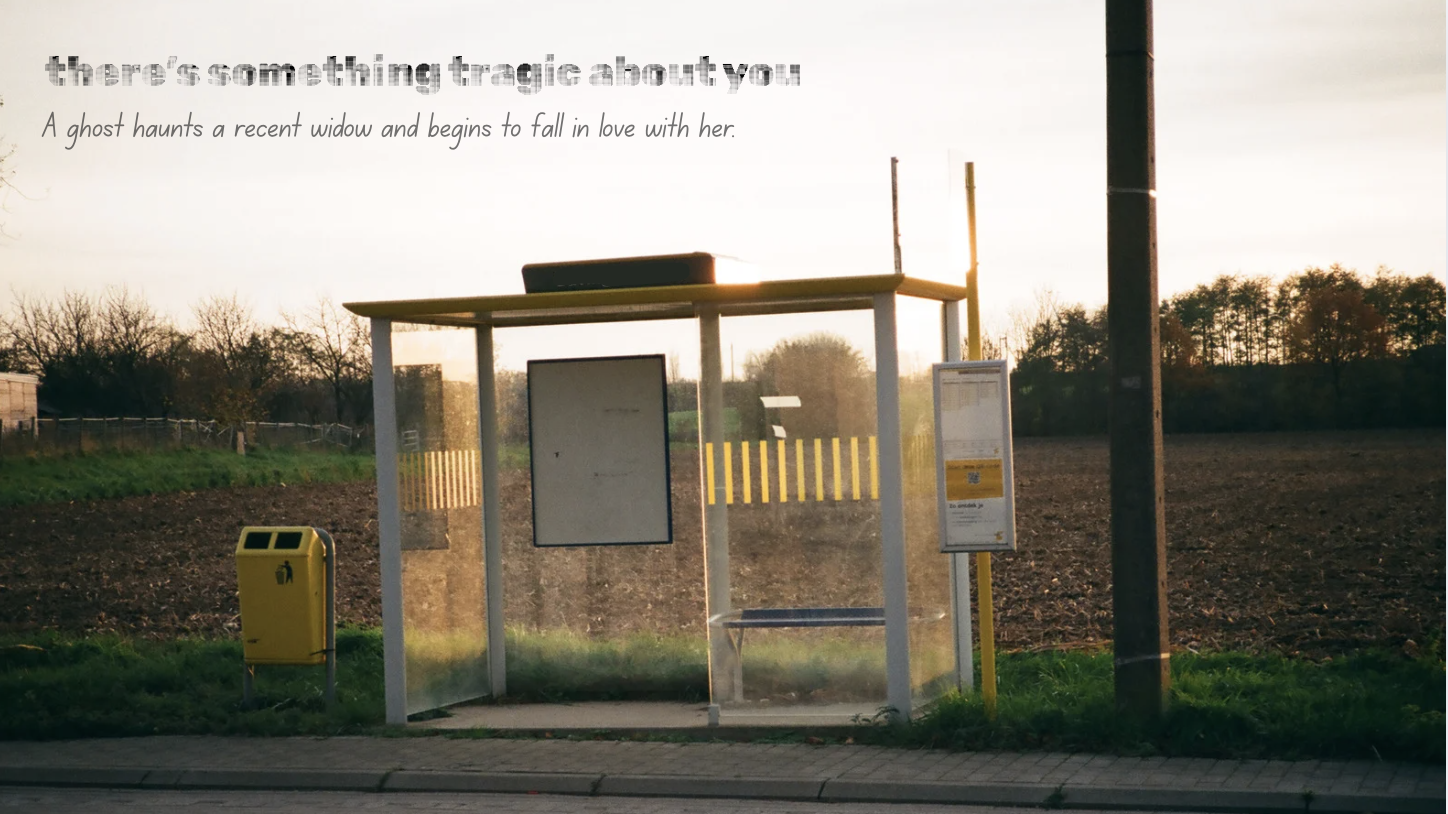
Sometimes I realize a story can be about two different things at once and I’m not sure which to pick, so I sort of let it be ambiguous. Such is the case with There’s Something Tragic About You, in which I could never decide whether the speaker, a ghost, was the widow’s dead spouse or someone who had never really had anyone to miss them at all. Either way I think there’s something both tragic and hopeful in this story - either learning to move on from something that breaks you or learning to connect with someone even when you think it would be impossible. I am fascinated by life after death - surprise, surprise - and this story is one of many of my explorations of that. Also, the title is indeed inspired by a lyric from Hozier’s song From Eden.
Read There’s Something Tragic About You here:
It feels cold. It feels dark, somewhat, but there’s a pinprick of light that you’re always trying to angle your face towards. Sometimes, you will spend hours and hours in the shade of your own thoughts, and believe so completely that you are dreaming. And then you wake and you remember you have not been dreaming at all, because in the reminder of the light, you recognize your in-between existence.
You reckon with the idea that you didn’t even attend your own funeral. You – or your mind – have been reduced to a series of gray sensations of semi-substantive memories which flicker through the air like projections. And you are not sure how you found her.
When it was fresh and the rain falling through your hands was still a novelty, you sat on a metal bench across from a laundromat and watched buses go by. This was a city you had never lived in, and you were not sure how you had gotten here, either. You vaguely remembered walking, for a long time, maybe even through the ocean, across its sandy floor. You emerged in a foreign place but didn’t feel its foreignness.
She rides the bus on the morning you start to notice her. Perhaps she has ridden it many mornings before this, and you were too involved in yourself to take notice, or perhaps a face like that – marked and riddled with grief that matched a face you had known long ago – is not easily disguised. Or perhaps, in death, you have become poetic.
You notice her, so plainly, sit down just beside you. She is wearing a blue silk shirt that hangs too loosely from her frame over a pair of dark skinny jeans. Her suede boots have scuff marks on the edges, and this entrances you.
There is stale grief on her, visible and dug deep. You watch as a leaf brushes by her face, and for a moment it appears to wipe dried tear stains away, and you wonder, daringly, if some other spirit watches her, and a brief spike of jealousy lodges itself up and under your ribs. Possession, you have come to understand, has much to do with love.
You have learned, being dead, that time is a realm from which you have been barred entry, and impulsivity has little meaning to you anymore, and you have nowhere to be anyway, and so when her bus comes you board it right alongside her and hover by her seat while she pages through a worn paperback. She rides the bus to a local bookstore and you watch outside a window, through gold-plate lettering, as she clocks in. Your sense of decency disappears when you follow the tug of your chest to settle yourself by the recent fiction shelf and watch her go about her day. It might be because you have never seen a person miss someone like she does – and does she miss someone like someone misses you? Or did anyone miss you at all? And is it selfish to watch her shelve rare books, running her fingers lovingly over the spines like she once touched the person who put those lines in the corners of her eyes?
Her voice is low and melodic and tinged with an accent you wish you were better at placing. Her movements are calculated and sharp, but only when she thinks other people are looking. In assumed privacy, she moves slow as syrup, the color of her faded away. The only thing bright about her is that silk shirt, too big for such a gaunt and deflated frame. Her shoulders hunch underneath the soft fabric.
When you follow her home, into an apartment starkly emptied of half of its belongings, you notice she sleeps in the shirt as well.
You begin to frequent her home, or her work, or anywhere else she happens to be that you feel justified to follow. You sit next to her at the bar while she downs a pint, crunches on bar nuts, and reads the same, tattered copy of Rebecca. You sit on her counter and watch her wash dishes, listening to music too upbeat for the lethargy of her hands submerged in the soap. The first month you are with her, she is stoic
while Lady Gaga blasts throughout her kitchen; after some weeks, she finds the courage deep inside to move her hips, to let herself forget. It is beautiful when she first allows herself to sing along.
You never find out what she is grieving, and you can’t ask.
You sit in her windowsill while she sleeps but you cannot watch her. As lovely as she is, the color of her skin like soft gum arabic, the curl of her hands around her pillow like a desperation both familiar and disquieting, you cannot look too deeply at someone who doesn’t know you are there. Instead, you turn your attention to the city outside, the rooftops other ghosts linger on and the stories you are, for some reason, far less interested in. At times, you drift out the window and float over the cookie-cutter streets, trying so hard to believe in fairy tales that you think you might drift through the clouds to Neverland. It might be nice not to feel so hollow anymore. But then, who would learn the end of her story? So you stay.
She has no one to talk to. She takes medication to keep extreme headaches at bay, and sometimes, while she sits in the doctor’s office, she opens her mouth like she might spill out all the things that come loose in her sleep, but she thinks better of it. When the barista asks how her day is going, in the time between passing over her credit card and receiving her earl grey tea, she says it is fine but the press of her lips is tight. You know all of these things because you are always with her, your time, nonlinear as it may be, occupied by her and the blue silk shirt she always sleeps in.
You want to believe that she knows you are there. You want to reach out and brush her hand and have her shudder from the cold. You want her to sip wine across from an empty chair, to start a conversation with the air around her to not feel alone. You want it to be romantic, as romantic as all the stories of the ghost who saves the girl, and you want it to be beautiful.
Instead, she sleeps and works and gets drinks with friends, learning to laugh little by little. She doesn’t sit in the same chair every night for dinner. Her grief slows to a trickle and escapes in small bursts, afternoons when she can’t stop herself from crying and long walks past the same few landmarks, tinged pinkish-rose in her vision. Like a scrape from a kitchen knife along the inside of her arm, she scabs and picks and heals and scars, and the wound becomes tougher to open, but the blood pounds just below the surface.
Your thoughts seem to blur into a single consciousness, incapable of remembering when or where you were or have been. The present is a piece of driftwood in a vast ocean of grey perception, and you cling to it. She lights candles that waver and extinguish when you get too close to them and you must remind yourself that you are the main character in your story. You have never known anyone else like you. You have never, you don’t think, known anyone else. You know her, and you know you, and this is how the years pass, in an endless, lovely tangle.
One early morning in the tangle the woman wakes up and removes the blue silk shirt, and with a deliberate movement she throws it in the hamper to be washed, and somehow it still feels like every other day. The smell of the morning comes in through the open window and the sunlight illuminates no dust in the air, and she makes her morning tea.
She finds herself a thermos and digs a pair of leggings out of the back of her closet, and she goes for a run. You drift amiably beside her, watching as she pants, adjusts the armband which holds her phone, and allows herself to listen to the one John Mayer song she has been skipping for a year or more.
At the end of her route, she sits on a bench by the river and watches the gentle waves swell and lap against the breaks. She pulls her sweatshirt around her shoulders but there is a chill in the air that is not uniquely your own. She turns off her music and it is just your sound she is hearing, the exquisite beauty of nothing.
In a few minutes, she will stand up and walk away, to an appointment, a shift at the bookstore, or simply to walk. You will fade away and find something else to do with your eternity, until you come back. For now, there is company, a pleasant one that you would like to imagine – that you hope – she feels.
It feels cold. It feels bright, somehow, this cloudy day where you are utterly alone and side by side. Possession, you have come to understand, has nothing to do with love.